
Red Citadel Down: How CRPF Delivered India's Most Decisive Counterinsurgency Victory
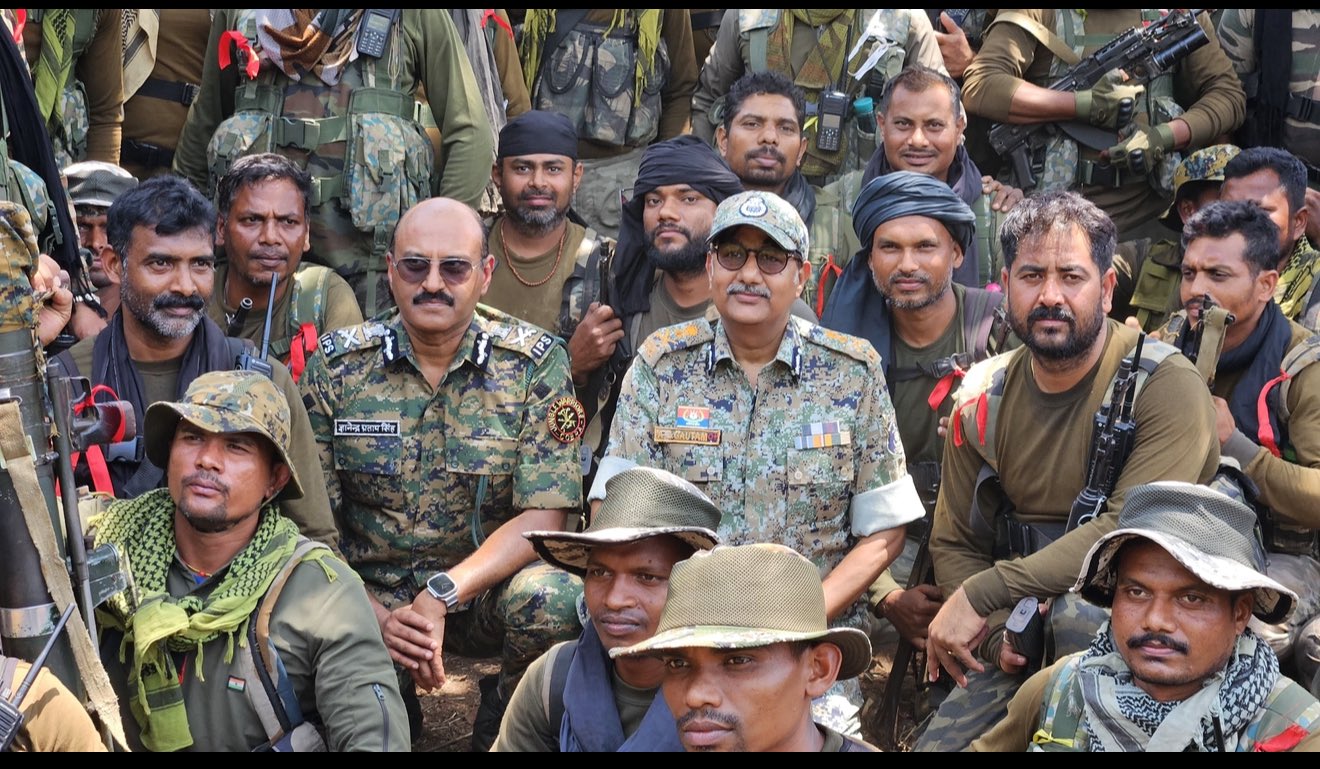
The red citadel has fallen. What was once a sprawling ideological and armed insurgency — deeply rooted across India's most challenging terrains — has been systematically, decisively, and strategically dismantled. The achievement of the Naxal-Free Bharat objective is not the result of a single strike or a fortunate breakthrough. It is the culmination of an iron-clad political will, a multi-force collective effort, and above all, a masterclass in modern counterinsurgency executed with rare precision by the Central Reserve Police Force(CRPF)
The Manoeuvre Warfare and Blitzkrieg
If there is one defining military characteristic of the CRPF's campaign, it is this — Manoeuvre Warfare and Blitzkrieg.
Under the strategic leadership of Director General G.P. Singh, the CRPF embraced a doctrine that bears striking resemblance to classical blitzkrieg and manoeuvre warfare philosophy — rapid, disorienting movement; high-tempo disruption; and the relentless application of force at the enemy's weakest seams. But unlike conventional blitzkrieg, this was a jungle war fought against an elusive adversary embedded within local populations and dense forest cover.
What made CRPF's manoeuvre warfare truly exceptional was the calculated boldness behind every tactical move. These were not reactive operations — they were preemptive, intelligence-driven thrusts designed to shatter Naxal command coherence before resistance could consolidate, a top source said.
A top source said, "CRPF has shown exceptional jointness and operational skills," said a top source within the security establishment. "Sustaining operational capabilities and mustering will for strategic risks — both were remarkably high within the force," added another senior official.
Operational Learnings
The recent operational success perhaps refreshes the memory of CRPF's initial-day operations decades ago, one of which was the landmark Operation Octopus (1986). This bold offensive crackdown saw the CRPF lead from the front in dismantling militancy with coordinated, high-intensity sweeps in Punjab. It established an early template: that counterinsurgency demands both aggressive posture and adaptive intelligence.
Decades later, Operation Black Forest last year elevated that template into a strategic doctrine. A high-risk, precision-driven operation, Black Forest demanded exactly the kind of calculated audacity that defines elite counterinsurgency — deep penetration, deliberate manoeuvring in hostile terrain, and the psychological unravelling of the adversary's command will. It worked. Naxal strategic capabilities were fractured.
The institutional memory of Octopus and Black Forest provided CRPF's current leadership with a rare inheritance — a living counterinsurgency playbook, refined through sacrifice and sharpened through learnings and skills.
The Final Blow: Redesign CoBRA
The Commando Battalion for Resolute Action — and its transformation in recent years proved to be the operational game-changer. CRPF's CoBRA units — the primary force for jungle warfare and counterinsurgency operations — underwent a sweeping technological and doctrinal overhaul. The upgrade was not merely about better equipment. It was about building a sharper, more precise strike unit with advanced counterinsurgency tactics, superior weapon handling, strategic communication, and a broader understanding of complex counterinsurgency tactics.
As a result, a new battalion, the 11th CoBRA battalion, was raised, a specialised unit now earmarked for counter-terror operations in Jammu & Kashmir. Crucially, ahead of the final operational phase against Naxal remnants, Director General G.P. Singh conducted a strategic review that led to a deliberate readjustment of force economy — repositioning CoBRA assets with surgical intent to deliver the finishing blow. "Right decisions in adjusting force economy in operations yielded desirable and strategic victories," a top source confirmed.
As the Naxal-Free Bharat deadline is met — almost to the hour CRPF's successful campaign demonstrated that modern counterinsurgency is not a war of brute numbers or firepower alone. It is a war of strategic will, operational intelligence, adaptive doctrine, and leadership courage where the RPF's performance in this campaign has delivered on all four counts. Under the leadership of DG CRPF GP Singh, the CRPF has perhaps rewritten India's counterinsurgency playbook, which will be studied, debated, and built upon by future generations of the force.