Superman at the Top, Nobody on the Ground: Amit Goel Must Realize That No One Defends Command When It Collapse
Arrogance Meets Crisis
Daryl Gates was chief of the Los Angeles Police Department(LAPD) — and by his own reckoning, he was absolute boss. Famously arrogant, openly dismissive of community leaders, and insulated by his immense high-profile status in Los Angeles, Gates ran a command structure where all decisions flowed from one man at the top. It looked powerful. It felt powerful. Until it wasn't.
When the 1992 Los Angeles riots erupted, the entire architecture of that centralized command collapsed in real time. Gates, displaying a staggering degree of detachment, left his own command center at the very moment the city needed him most. By the time he attempted to reassert his "boss" image, the damage was irreversible — his officers felt leaderless, the public was outraged, and his high-profile political connections, including the Mayor himself, turned entirely against him. He was not just politically isolated. He was a cautionary tale.
South West's Slow-Motion Crisis
The incomprehensible police response to the Vasant Vihar Enclave district incident is not an isolated lapse. It is not an episodic failure. It is a window into something far more troubling — a systemic disconnect between ground-level realities and district police administration.
The failure to actively attend to a complaint, the blatant disregard communicated to the complainant, the institutional indifference radiating through every layer of the response — none of this should be absorbed as routine. This is a state crisis in the making, and South West District sits at its epicenter.
According to top sources and credible reports, South West District has witnessed a moderate but telling rise in crime. The nature of these crimes has been serious. Post-emptive police action remains functional, but pre-emptive, professional policing is dangerously loose. The silent crisis brewing here stems not from a lack of resources alone — it stems from deep-seated administrative dysfunction and a dangerously distorted policing philosophy.
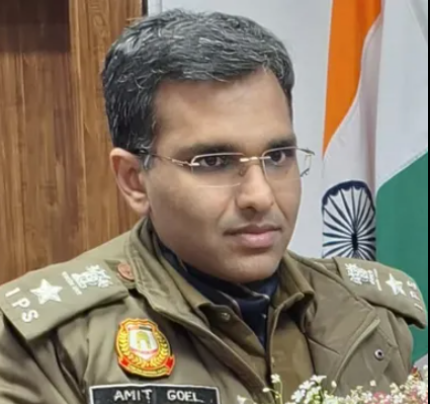
DCP Goel's Own Theatre
Amit Goel's approach, according to a top source, reads like a desperate attempt at sophistication that consistently backfires. Police administration does not need the theatre of professionalism — it needs actual work, measured across three clear counts:
1- Strategic flexibility — the ability to read situations and adapt, not manage them from an altitude of assumed superiority.
2- Personal intervention and active monitoring — not a hands-off approach dressed up as delegated authority
3- Sound judgment and accurate field assessment — the capacity to distinguish between what looks like control and what actually is control
Goel, sources indicate, appears to be riding high on a centralized, top-heavy style of policing — a vintage, loose-command philosophy that history has repeatedly discredited.
"That case could have been swiftly resolved. Instead, district police top brass chose to become paper tigers and perform senseless arrogance." — Top Source. The hierarchy collapsed not because there were too few people in the chain — but because those at the top acted as sole arbitrators, confusing authority with competence. The fact that PHQ and Army HQ intervention has been drawn into this matter speaks volumes about the degree to which Goel's command structure has frayed at its edges.
The Irony of IIMC Lecture
DCP Amit Goel once delivered a talk at the Indian Institute of Mass Communication (IIMC) on police-journalist relations and the principles of community policing. The subject matter was theoretically sound, no doubt eloquently presented, and professionally credentialed. But credibility is not built in lecture halls.
"Anyone can do theoretical lecturing. Results on the ground remain poor." — Top Source said. According to insiders, Goel possesses a loose practical grasp of how community policing actually functions in the field. "A talk on police-journalist relationships means nothing if the district police cannot even professionally respond to a civilian and specifically that of senior Army official's complaint. The optics are damaging — the substance, more so" a top source
Need of Sagacious Policing
The path forward demands what might be called sagacious policing — a policing model that is proactive, analytically grounded, insightful, and institutionally humble. It is not reactive. Top source quipped that perhaps Goel inspires too much confidence because of his background and connections but he must understand that background only looks good and connections only help when foreground is in line with background which is severe contrast because the boss mentality often lead to leadership collapse if not conducted well.
The question for DCP Amit Goel is not whether he is credentialed, or capable of an impressive lecture. he question is simpler — and far more urgent: When the moment comes, will he be at his command center, or will he have already left the building?