
A Lost DG: Hands-off approach and Rusted Operational Temperament: How Nitin Agarwal Lost All Controls
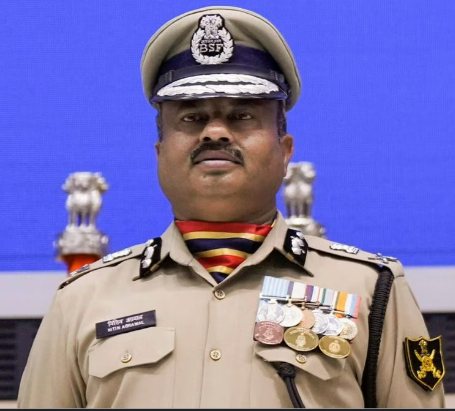
The last time the government took swords for top helms was the CBI six years ago, and even before that, the abrupt sacking of Anil Goswami, the then Home Secretary. Today's government has made a few things distinctively clear: no nonsense will be tolerated, and officers' capacity to deliver in pressure situations. However, Nitin Agarwal's sudden and unexpected departure opened a wide perspective, which, to some extent, helped the Ministry of Home Affairs open its misted eyes.
Nitin Agarwal's appointment as DG BSF received mixed views from power corridors. The government's decision to bypass a few calibre officers didn't go too well, but the top brass trusted Agarwal's professional and operational competence. Little did they know that MHA's assessment of Nitin Agarwal was short-sighted. Arguments are going on in power corridors that lack of coordination was the key behind Agarwal's removal, but there is more to it, which puts Nitin Agarwal's competence and operational temperament to test where he miserably failed. While lack of coordination was certainly a factor, it was not the sole reason for Agarwal's ouster. According to top sources, there were four significant reasons behind the Ministry of Home Affairs' bold move, each carrying its own weight in the decision-making process.
First—Non-Accommodative—Nitin Agarwal outright rejected deputation extension requests from BSF cadre officers working in other agencies. A strategic and wise officer would have used them for inter-agency coordination instead of hitting their morals. This shows poor calculative skills. This generated resentment among BSF cadre officers, which increased after seeing multiple failures to deliver border security in J&K.
Second- Arrogance: Sources add that prior to the appointment, Agarwal's rapport was quite accommodative, but post-appointment, DG BSF Nitin Agarwal's rapport with many changed that didn't go well down in power corridors. It's natural to build a reputation and high esteem after reaching the top helms, but cutting down roots and egoism will disturb your long sustenance and professional approach as it will make you rigid, and the operational field demands a rigid yet flexible approach.
Third- Failure of Inter-agency coordination- Nitin Agarwal's massive failure was destabilizing the inter-agency coordination of BSF. The failure occurred due to the above two reasons: Agarwal's reputation fell within the force, his subordinates were not taking him seriously and were even frustrated with him owing to his arrogance and non-accommodative nature. As a result, he went disarrayed. The BSF cadre officers, who should have acted as links between various agencies, failed as Nitin rejected their extension proposals, which led to the erosion of in-depth coordination and intelligence developments. A top source said that the BSF unit in Jammu and its echelons refused to comply with Nitin Agarwal's directives, which lacked operational guidance, which a DG should have discussed with the unit before strategy execution to know their situation and assessments of ground
Fourth- Nitin Agarwal's rusted operational temperament- Any DG-level officer with decent paramilitary experience can execute a localised operation, but the job of DG BSF goes much beyond that, from conducting wide-scale operations to operating under intense pressure where officer with robust credentials needed to lead the world's most significant border security force. Agarwal's operational temperament almost collapsed when he faced heightened security South of Pir Panjal, an area under BSF operational control and failed to secure the frontline and support Army's counter- terror operations. Sources added that Agarwal was disarrayed, leading him to make a hands-off approach, but that failed because of damaged rapport within the hierarchy.
Failure of Nitin Agarwal to sustain the operational pressure shows a grim reality that IPS officers having a ready-made template/title of "expert" in a certain domain get the job, but in reality, their operational skills rust within the time, and they don't improve and push beyond boundaries. This also serves as a good lesson to MHA that short-sightedness' in assessing an IPS officer's capacity sometimes backfires at crucial moments.